
Activity Feed
BronchandNTM360social welcomes new member Alfred Moran who
joins 5,672 current members of our community.
We're glad you're here!
Activity Feed
I have also I started and continue on the higher dosage. It has helped. I had the best winter I ever had but even though I woud say I still have a lot of mucus and coughing my breathing is improved. But I find that alot of how my mucus and coughing is related to weather. When the barameter and humidity change so does my production and I have come up with a good routine. I still say it is helpful. Hang in there.
Lucinda, Christina,
You are most welcome! It is important for individuals to understand the differences in services available on the healthcare continuum. I worked as an Assisted Living Administrator at one of the first Assisted Living facilities in NJ in the 1990s; I have many fond memories and great stories from working in this fulfilling role. :)
I LOVE this new app! Not only does the community have our resources at their fingertips, but it is also much easier to connect with our community from anywhere!
Thank you for this thoughtful post, Katie. Remembering all those affected by that day.
Hi LaRosa.
I haven't heard of those in our patient community feeling as though Brinsupri is less effective over time. I would talk with your health care provider about your concerns. It is possible, as Katie mentioned, that you may need to go up to the higher dose. Also, the specialty pharmacy that is distributing your Brinsupri should have additional information. You can lean on their patient support team for questions like these. They are a wealth of information. Keep us posted on your journey.
What a wonderful wealth of information about assisted living. Thank you for keeping our community informed, Katie.
The CareCentral app is such a great tool for patients and healthcare providers- so much valuable information available at your fingertips. I hope that you will take a moment to download this app and share it with others.
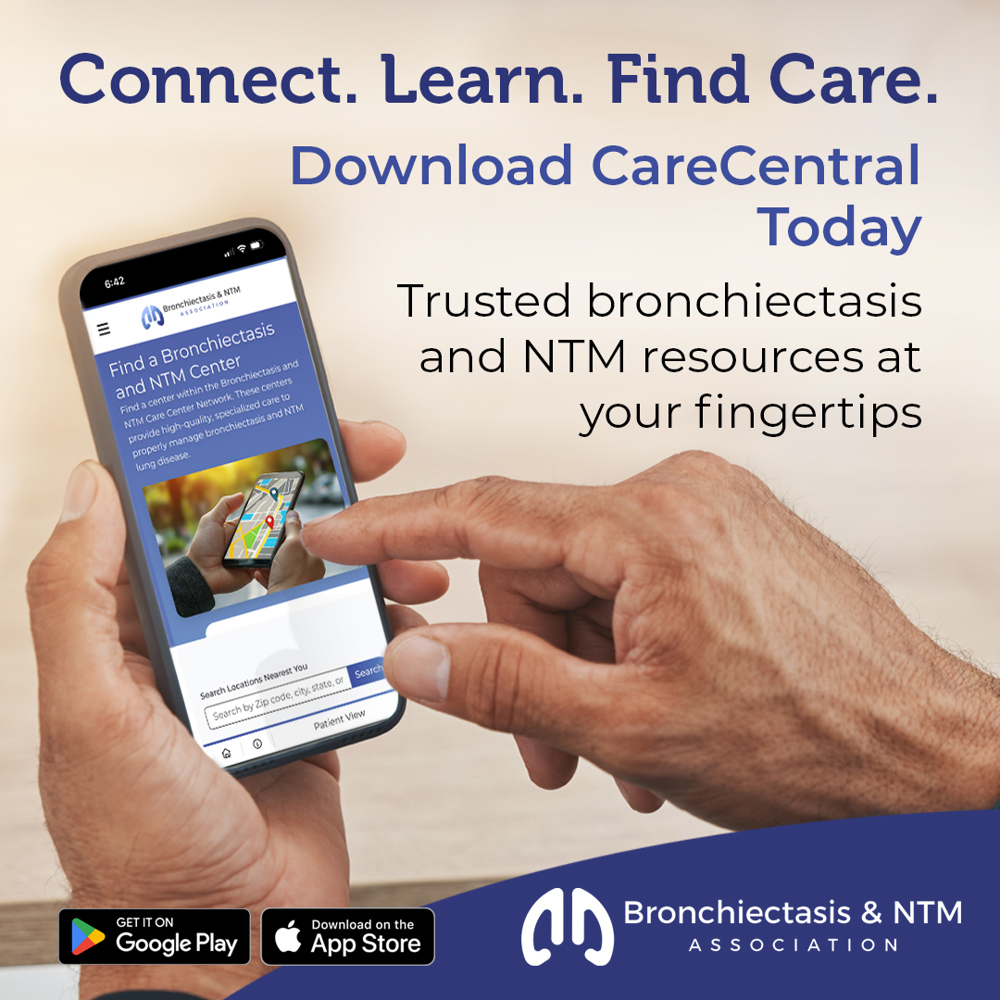
Connect, learn, and find care—all in one place with our new CareCentral app.
Access trusted education, connect with others through BronchandNTM360social, and use the Find a Doctor feature to locate expert care at a Bronchiectasis and NTM Care Center Network site near you.
Plus, explore additional interactive tools and resources designed to support your lung health journey.
Download CareCentral today from the Apple App Store or Google Play and take your bronchiectasis or NTM lung disease resources with you wherever you go.
This is good information Katie. My mother is in an assisted living facility. She doesn't have lung disease, but she has other chronic conditions. Most residents at the facility use the in-house Nurse Practitioner, but for her chronic conditions we take her to see specialist and then have the NP at the assisted living to follow the orders. Most NP's are familiar with heart and diabetes patients and their medications and treatments. But for bronchiectasis and NTM patients, the resources you shared are valuable tools for the in-house NP. These resources can help their residents having a better quality of life while living in an assisted living residence.
Additional information on the Concepts of Assisted Living is listed below:
1. 🏠 A home-like environment-Residents typically live in their own room, apartment, or suite rather than a hospital-like room. The goal is to preserve a person's sense of home, privacy, dignity, and belonging.
2. Independence-Assisted living is designed around the idea: Help me with what I cannot safely do myself—but let me continue doing what I can do. This might mean assistance with: Bathing, dressing, meals, medications, housekeeping, transportation, mobility, and appointments, while allowing the individual to maintain as much independence as possible.
3. ❤️ Person-centered care -Modern assisted living increasingly emphasizes person-centered care—the individual's preferences, routines, goals, values, and definition of quality of life.
4. 🧑⚕️ Support rather than constant skilled nursing- Assisted living generally occupies a space between completely independent living and skilled nursing care. A person may have chronic lung disease and may need assistance with activities of daily living while still being cognitively independent, socially active, and capable of making their own health decisions.
This information is for educational purposes only for Assisted Living Week. The personal and healthcare needs of some individuals may change over time: many people prefer to stay in their own homes with assistance as needed. We all have choices to make depending on our own personal circumstances.
Hello! This week is National Assisted Living Week. I want to begin by writing a little about the history of Assisted Living Facilities. When we hear assisted living, we may picture a nursing home. But that isn't necessarily what assisted living is. The concept was developed to provide support in a home-like setting while helping people maintain independence, dignity, choice, and quality of life.
Assisted living, as we know it today, developed largely in response to the limitations of the traditional nursing-home model. Beginning in the 1980s, a new philosophy of care began to emerge. Advocates promoted more individualized services and greater independence as alternatives to traditional nursing facilities.
During the 1980s and 1990s, assisted living expanded rapidly, and a variety of models began to emerge. By 1998, there were an estimated 11,459 assisted-living facilities in the United States. Today, there are approximately 39,000 assisted-living and residential-care facilities, serving approximately 1.2 million residents.
Do you or a loved one live in an assisted living facility? Are you a caregiver for someone who does? If so, please consider sharing the resources below with your assisted living healthcare team. These resources can help staff better understand bronchiectasis and NTM lung disease and the unique needs of individuals living with these conditions. 💙 Knowledge leads to better understanding, better communication, and better care. Please share these resources with the healthcare professionals who support you or your loved one.
All About Bronchiectasis Booklet https://social.bronchandntm.org/resources/detail/25
Do You Know About NTM Lung Disease (Part1)https://social.bronchandntm.org/resources/detail/8
Please let us know if you have any questions.
Welcome La Rosa! We are so happy to have you here!
Welcome to our community - we're really glad you're here!
LaRosa,
Hello! Welcome to the community; I am so glad you found this site. I have not been on Brinsupri nor have heard of a similar issue thus far. Brinsupri has only been on the market for over one year. Have you discussed this with your Pulmonologist? Perhaps, they will want to increase the dose to 25mg to see if it helps since the 10 mg was helping you initially. Our bodies get accustomed to a medication and often an increase in dose is needed for some medications. Please let us know what your Pulmonologist suggests. We look forward to hearing back from you.
Hello
I'm new here. :) I wanted to connect with others to see if anyone else is experiencing what I am with Brinsupri.
I have been taking Brinsupri 10 mg for almost a year now. At the beginning of the fourth month I felt a noticeable improvement and had less and less phlegm and cough, as well as less breathing issues and fatigue, as the months progressed. It was such a relief! After 30 years! But recently I have noticed that I feel like I am going backwards, as though my body has gotten used to the medication and it isn't working as well as it was.
Has anyone else on Brinsupri had this experience?
💙 Celebrating Grandparents in Our BNTM Community 💙
Wishing all grandparents, soon-to-be grandparents, and those acting in the role of a grandparent a wonderful day! :)
Grandparents have a special way of making life feel a little warmer, a little wiser, and a whole lot more meaningful. For those living with BNTM, being a grandparent may sometimes feel different. You may need to pace yourself, plan around your respiratory treatments, conserve your energy, or find creative ways to stay connected with the people you desire to be with.
And for grandparents supporting a loved one with BNTM, your encouragement, patience, and understanding can mean more than you will ever know. Whether you're sharing a hug, watching from the sidelines, making a phone call, sending a text, or simply being there—your ongoing presence truly matters. Ongoing support means so much at every stage in our lives.
Today, we celebrate the grandparents in our BNTM community and all the love they give and receive. Happy Grandparents Day! 💙 Please share any special plans you have for this special day- we would love to hear from you!
Good to know! Thanks, Lucinda.
Interesting that you asked. At first the doc prescribed ceftin, but my doctor was off so it was another doc who apparently did not check my file that I often get pseudomonas infection. So I called back and they prescribed cipro, which is one of the two that always worked better for me (the other being levoquin). I suggested a sputum sample but the first doc disagreed and sent me for a chest x-ray instead (it was negative).
Cindy... I understand. As the coordination of care is the expectation, not all Centers offer it in the same way. Vanderbilt is aware and is working on creating a coordination of care model that Dr. Flume spoke about. I'm glad you are seeing Dr. Tolle.
Thanks, Lucinda. Dr James Tolle is my pulmonologist but this is the first I am hearing about the Center of Excellence designation at Vanderbilt. I suppose that designation plays differently at each institution. I recognize that it takes leadership and funding to develop the kind of coordinated team approach that Dr Flume described. Vanderbilt at-large, of course, offers all the medical specialties and ancillary services that would comprise a team like the one that Dr Flume outlined. What I don’t find is a system of coordination of care and support like he talked about. Don’t get me wrong, Dr Tolle is a great guy and luckily I did eventually make my way to him because of his interest in bronchiectasis. For the most part, I’ve been happy with my care at Vandy and grateful for the range of available specialties. I know that many people who need this care are not nearly as fortunate—if they can find it all they have to travel to access it. For most people it’s a solitary journey.
September 11 — We Remember. We Grieve. There are some days when words simply aren’t enough. September 11 is one of those days.
We remember the lives taken, the families forever changed, the first responders who ran toward danger, and everyone who has carried the weight of that day for 25 years. Reaching out to those who have been dealing with respiratory issues since 911: it has been a long and challenging journey, but you are not alone.
Grief doesn’t always belong to one particular day. For those of us living with bronchiectasis, NTM, or other respiratory illnesses, we understand that grief can take many forms. We can grieve the person we were before our diagnosis. We can grieve quietly—even while smiling, laughing, and telling everyone we’re “doing okay.” And sometimes, the greatest act of courage isn’t fighting harder; it is the strength to get support and to keep moving forward.
And for everyone in our BNTM family who is carrying grief today—whether from 9/11, from chronic illness, or from a loss that only you understand—please be gentle with yourself.
You don’t have to hide your grief.
You don’t have to apologize for it.
And you don’t have to walk through it alone.
🕊️ We remember those we’ve lost. We honor those who continue to fight. Please check in with us regularly to let us know how we can assist you.
❤️ Today and always, we remember.

Today, on the 25-year anniversary of the September 11 terrorist attacks, we remember the 2,977 individuals who lost their lives, and we honor the courageous heroes who risked everything to save others. #NeverForget
Cindy,
The Care Center Network is a program consisting of centers of excellence. Existing Centers such as Vanderbilt apply to the Care Center Network and if the meet the requirements then they are accepted into the Care Center Network. Vanderbilt, specifically, Dr. Christina Fiske and Dr. James Tolle applied and met the requirements and were accepted. Both are part of the Care Center Network already. So if they are your doctors, you are seeing the right ones. If they are not your doctors, then I don't know why someone at Vanderbilt did not refer you to them. I hope this helps.
What kind of antibiotics are you on for the flare up
Lucinda,
Glad you remember me! I look forward to exploring BNTM further and attending future coffee breaks, etc.
I’m a bit mystified as to why I’m in the dark about the Center at Vanderbilt. My pulmonologist is at Vanderbilt and sees a lot of nonCF bronchiectasis patients. He has never mentioned the Center although it seems to me that I would be an obvious referral. Do you have any names of the clinicians there? Do you know if they are based in Pulmonology or Infectious Diseases?
C.
When you walk into a healthcare facility, who is making sure the environment is safe from the spread of infection? Why can this be especially important for the BNTM community? For people with bronchiectasis and NTM, infection prevention is especially important because healthcare facilities bring together many people with respiratory illnesses.
An infection control nurse plays a major role in protecting patients, healthcare workers, visitors, and the community from infections acquired or spread in a healthcare setting. What does an infection control nurse do? Their job is essentially to prevent infections before they happen and stop them from spreading when they do occur.
Key responsibilities include:
- Monitor infections: Track infections occurring in the hospital, clinic, or other facility and look for patterns or increases.
- Investigate outbreaks: If several patients develop the same infection, the infection-control team investigates where it may have originated and how it is spreading.
- Develop infection-prevention policies: They help establish procedures for hand hygiene, cleaning, sterilization, isolation, PPE, respiratory precautions, and other safety measures. They address questions such as: Should this patient be separated from other patients? How can we protect vulnerable patients in the waiting room?
- Educate healthcare workers: They train staff on infection-prevention practices.
- Monitor compliance: They may observe handwashing, PPE use, cleaning procedures, and other activities to make sure policies are being followed.
- Manage isolation precautions: They help determine what precautions are appropriate for patients with potentially transmissible infections.
- Surveillance: They follow organisms such as C. difficile, influenza, tuberculosis, and other healthcare-associated infections.
- Work with public health departments: Certain infections or outbreaks may need to be reported to the CDC, state, and Local health departments
Do you have any infection control experiences or suggestions that you would like to share with the community?
thank you (me too) :-)
I hope that you feel much better by the time of your appointment.
Hi Cindy,
I remember you!! Yes, it's a small world. So glad you found us and it's great to hear from you.
Bronchiectasis and NTM have always been recognized within the COPD Foundation, but in the past couple of years the Bronchiectasis and NTM Association and the Care Center Network were recently added as a division of the COPD Foundation. As you mentioned, we are a great resource. And the Coffee Break's are an added benefit. As far as Vanderbilt, they are part of our Care Center Network and they have a good team.
I look forward to seeing you on more Coffee Breaks and post on our 360Social. Great to have a fellow Alpha here :)
near the end of October
Thank you for joining us today for a great presentation on the Care Center Network. Please let us know if you have any follow up questions. 😍
Thank you so much to everyone who was able to join us for today’s Coffee Break! 💙
Dr. Flume gave such a terrific presentation, and I’m truly grateful that he took the time to spend with our community, share his knowledge, and answer questions. Having experts who genuinely care and are willing to give their time to our community means an awful lot.
And thank you to everyone who joined us, listened, and brought your questions. You’re what makes these conversations so worthwhile.
It was great spending the time together, and I’m already looking forward to seeing everyone again next month!
Hi Lucinda,
I just attended the zoom coffee break with Dr Flume and recognized you as the person who organized an Alpha 1 support group in Nashville several years ago. Small world!
I have severe bronchiectasis and have had 2 bouts of NTM for which I was treated at Vanderbilt ID and Pulmonology. BNTM has never been mentioned to me by anyone at Vanderbilt, yet I see that Vanderbilt is listed as a Center. I stumbled upon BNYM myself about a year ago. It’s a great resource—I feel very late to the party!
Best,
Cindy
You may have wondered: “Why would my pulmonologist want an Infectious Disease (ID) specialist involved in my care?”
It doesn’t necessarily mean you’re “more sick.” Sometimes it means your doctors want another layer of expertise.
An ID doctor may be brought in when:
🔹 A difficult or unusual organism is identified
🔹 NTM is suspected or confirmed
NTM treatment can involve multiple medications, potential drug interactions, side effects, and prolonged therapy.
If there is a question of infection vs. colonization A positive sputum culture doesn’t always mean that treatment is needed. Your clinical symptoms, imaging and microbiology determine the treatment plan.
🔹 The infection keeps coming back
An ID specialist may help determine why and whether additional testing or a different treatment strategy is appropriate.
🔹 Antibiotic choices become complicated- Resistance, allergies, medication interactions, or previous treatment failures may require specialized infectious-disease input.
🔹 Treatment causes significant side effects- The ID doctor can work with the pulmonologist to balance treating the infection while minimizing medication toxicity.
Sometimes the most important role of an ID specialist is simply helping the team answer: Do we treat, what do we treat with?
Has your pulmonologist ever referred you to an Infectious Disease specialist? Did having an ID doctor involved change your treatment plan, or understanding of your cultures? Please share your experience below to assist other members on their journey.
Eddie,
You are most welcome. Let me know if you have any other questions. As mentioned above, I hope you are getting the right treatment. I assume that your healthcare provider has reviewed the right type of airway clearance for you? A doctor/ a health care team will suggest specific airway clearance depending upon the results of your chest cat scan. Would suggest to get a referral from your pulmonologist to a respiratory therapist for advice if you haven’t already done so. Preventative measures , going forward are far better than dealing with ongoing curative measures.
Thank you very much.
I'd replace my cell phone with a Star Trek Communicator. Brandon, please "make it so!" 🖖
Eddie M,
Hello! Let me start by reviewing a few terms: Bronchiolectasis → the smaller airways/bronchioles are widened or damaged; bronchiolectasis may appear as tiny widened airways on a chest cat scan. This condition is sometimes associated with mucus plugging, inflammation, or small-airway disease.
Bronchiolectasis can be relevant because it may reflect small-airway involvement and can occur alongside the classic bronchiectasis pattern.
Another common term is Bronchiolitis- an inflammation and swelling of the very small airways deep inside the lungs, called the bronchioles.
Bronchiolectasis = the small airway is widened.
Bronchiolitis = the small airway is inflamed.
These two conditions can occur together. Inflammation and repeated infection involving the small airways can contribute to structural damage and bronchiolectasis over time.
I had bronchiolitis years ago and was totally exhausted. I was treated with antibiotics and steroids at that time; it took several months to start to feel like myself again.
I hope that you are getting the treatment you need and that you will feel better soon.
I have been diagnosed with bronchiolectasis, not bronchiectasis. I can find almost nothing about this condition. Are there other members with this condition? I'd like to start a discussion. Thanks
Ron,
I am glad you are making some improvement. When is your next scheduled appointment?
Join Professor James Chalmers as he shares key highlights from the European Respiratory Society Congress, including the latest research in bronchiectasis and NTM. Held in Barcelona, Spain, from September 5–9, 2026, the ERS Congress is the world’s largest respiratory meeting and a leading global forum for advances in lung health, science, and clinical care. This year’s program highlights breakthrough research, global collaboration, and a strong focus on patient partnership, with an emphasis on shared decision-making and co-creating better care.
The core theme, "United for better breathing – partnership between patients, clinicians and researchers,"
Living with bronchiectasis or NTM lung disease can bring a lot of questions. You do not have to navigate them alone.
Join National Jewish Health experts on Saturday, September 19, for a one-day conference created for patients, family members and caregivers.
Attend in Denver or from home by Zoom and learn more about treatment, airway clearance, medication side effects, nutrition, test results and everyday care.
Need to take a break or miss a session? Recordings are included with registration, so you can watch the presentations later at your own pace.
🖖 Happy Star Trek Day, Bronchiectasis and NTM 360social!
Okay, I’ll admit it—I’m a bit of a Star Trek fan, so there was absolutely no way I was passing this one up. But even if Star Trek isn’t your thing, stick with me, because there’s actually a pretty good connection here.
For all the spaceships, aliens, and “Beam me up!” moments, Star Trek has always looked toward the future and asked, “What could be possible?”
I think that question means something special in the bronchiectasis and NTM community.
For a long time, many people living with these diseases struggled just to get answers. NTM can be complicated—different organisms, long treatment courses, multiple medications, side effects, cultures and testing, and sometimes a whole lot of waiting and uncertainty along the way.
But people are paying attention. Research is growing. We’re learning more about NTM and bronchiectasis, new treatments are being studied and developed, and patients are helping researchers and health care professionals better understand what living with these diseases actually looks like.
There’s still a long way to go, but “What could be possible next?” is a pretty exciting question to ask.
And Star Trek wasn’t only about technology. It imagined people with very different experiences learning from one another, working together, and trying to make things better.
I kind of love that for our community too.
Whether you’re living with bronchiectasis, NTM, both, or you’re here as a caregiver, everyone brings something different to the table—and sometimes what you’ve learned along your journey can make someone else’s road a little easier.
So let’s have some fun today. 🖖
If you could borrow ONE piece of Star Trek technology for your life right now, what would you choose?
I’m still taking the transporter. Doctor appointment three hours away? Beam me over. Traffic? Nope. Airport? Absolutely not.
Live long and prosper, everybody! 🖖💙
I called my doc and they gave me antibiotics. I have not gone in for a visit, as there is some improvement, albeit the improvement is very small/slow.
Ron,
Bad air quality and humidity can take a toll on our lungs. Do you have a doctor's appointment scheduled so they can listen to your lungs and examine you? Your lungs take time to heal, but you should feel better soon. Recovery time varies from individual to individual, but you should feel better after a month if the antibiotic worked. Do you have other comorbidities that may be impacting you? I think a doctor's visit or phone call to discuss this is worth checking out.
Tim,
Lol! Were you really going to procrastinate on reading our posts? Have a good day!
Happy Labor Day! Today we recognize and celebrate the contributions of workers in every field of work.
Lung health and labor are deeply connected. Exposure to smoke, dust, fumes, and other pollutants on the job can increase the likelihood of developing bronchiectasis, NTM lung disease, and other chronic lung conditions. In honor of Labor Day, help us spread the word about the importance of occupational protections and safety equipment so we can build a healthier future for all workers. Enjoy your day!
Brandon and Katie, I'll read these later...
Kidding! You both make great points about the importance of taking the time to take care of yourself and telling yourself that it is ok to rest.
I also agree that if you love ice cream, it's important to never procrastinate getting yourself some! 🍨 😂
After an exacerbation, how long does it take most of you to return to your steady state? My most recent flare-up occurred on a very humid day, when the air quality was terrible (including smoke from the Canadian fires). This was back in July. After a round of antibiotics, I am patiently waiting to return to my "normal." I have stepped up my airway clearance efforts but improvement is very slow. At least this is my first flare-up this year (perhaps that is due to my starting Brinsupri). Thank you all in advance for your thoughts.
Brandon,
Great post- thank you!!!! The line in your post -“ Sit your butt down and rest for a while” is something I procrastinate. Many of us have difficulty giving ourselves permission to rest even though our bodies may be screaming out for rest at times. After many years since diagnosis, I still feel bad/ guilty about not being very productive at times; I need to be reminded by others that it is okay to rest as needed. “Resting as needed “ is as important as medications, exercise, good nutrition and more. :)))
It is not our intention to serve as a substitute for medical advice and any content posted should not be used for medical advice, diagnosis or treatment. We make every effort to support our members, our medical professionals cannot and will not provide a diagnosis or suggest a specific medication; those decisions should be left to your personal medical team. While we encourage individuals to share their personal experiences with Bronchiectasis and NTM, please consult a physician before making changes to your own Bronchiectasis and NTM management plan.
Community posts are monitored by the 360social Community Manager, as well as staff respiratory therapists, educators, and other medical professionals.