
Activity Feed
BronchandNTM360social welcomes new member Alfred Moran who
joins 5,672 current members of our community.
We're glad you're here!
Activity Feed
Care Centers offer the specific lab work that can identify possible causes of bronchiectasis. It is important to identify the root cause of a disease when possible, before a treatment plan starts.
We must continually remind ourselves that "This too shall pass". We will get through this air quality challenge and will be able to enjoy some nicer summer days. We must keep ourselves busy with a new hobby, some good diversional activities while mostly indoors at this time..
Tim,
Hello! Sorry to read that Michigan is already in the Red Zone. I am in the Orange Zone and will soon be in the Red Zone in the Northeast. The EPA developed the AQI (Air Quality Index) to provide information on the health effects of the most common air pollutants and how to avoid them. Below is a link to review more information about the Air Quality Index: AQI Basics | AirNow.gov
Please stay safe and take necessary precautions. Let us know if you have any questions.
Clinical trials are done to test treatments or therapies for specific diseases such as NTM and bronchiectasis. These trials help us to understand what works and what does not. Clinical trials challenge current treatments or standards of care for the advancement of care. Suggested questions to ask before beginning a research trial:
Participation
What is the purpose of the trial?
How will this treatment be different from what is currently being used?
How long will I be in the trial?
How many visits will I need to make to the hospital or clinic?
What kinds of tests and treatments are involved?
How will the doctor know if the treatment is working?
Who will oversee my care?
Who can answer questions I have during and after the trial?
Risk and benefits
What are the possible side effects or risks of the new treatment?
What are the possible benefits?
How do the possible risks and benefits of this trial compare to those of the current treatment?
Rights and costs
How will my health information be kept private?
If I decide to leave the trial, what other options will I have?
Who can help answer questions from my insurance company?
Are there any out-of-pocket costs if I take part in the trial?
Are there payments for participating or to cover travel?
Please let us know if you have any questions. I will continue to post more information on clinical trials throughout the week. Please stay tuned. :)
Thanks for sharing that, Tim!
The heat is no joke, especially when you're dealing with a lung condition. Even people without breathing issues can feel wiped out, so it's easy to see how much harder it can be for those of us who already have to work a little harder for each breath.
If you have to be outside, try to get things done early before the day really heats up. Take your time, pace yourself, and don't feel like you have to push through it. It'll still be there later.
And with everything else you're already juggling—airway clearance, medications, and just day-to-day life—I hope you're able to stay cool, stay hydrated, and make it through this stretch of hot weather with as little trouble as possible. Easy breathing, my friend.
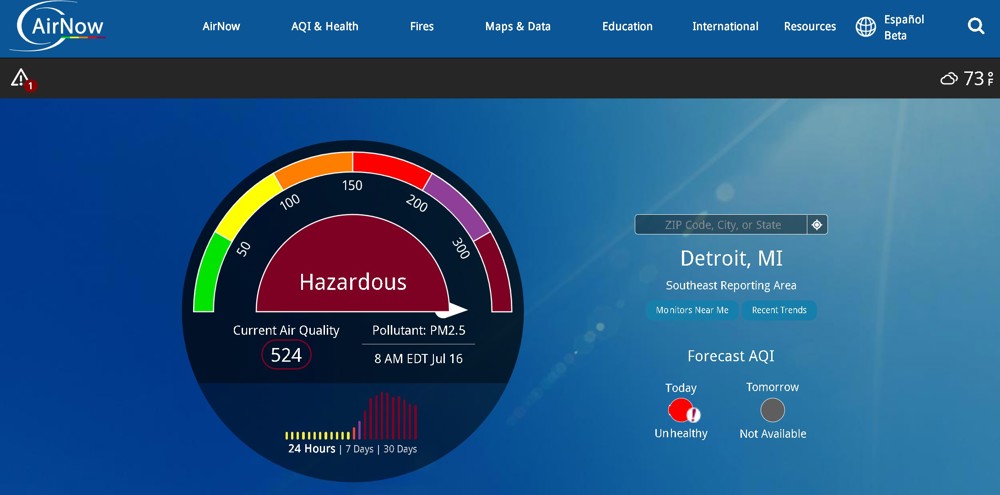
Good morning! This is the air quality report in our area this morning (Detroit/Southeast MI). Looks to be a bad air quality day for many areas today. Please stay safe everyone!
Hello Gretchen,
I am glad you reached out with this important question. I am curious about how much blood did you cough up with your four episodes?
Bronchial artery embolization has become mainstay therapy for many patients with both acute massive hemoptysis and chronic hemoptysis from a variety of causes. While this procedure can be lifesaving, recurrence and complications can occur.
I don’t know anyone who has been through this procedure. Have you asked your doctor about the number/ volume of cases UNC does each year and their success rates?
Hi! I'm 82. Have had bronchiectasis for probably 40 years. Hemoptysis 4 times: 2009, 2017, 2026 (2 x's). Am considering – seriously – BAE (Broncial Artery Embolization) and would LOVE to hear from anyone with experience with this procedure. I had a consult today with a UNC Interventional Radiologist who would perform the BAE.
Boil water for at least 3 minutes after it starts to boil, then cool it for at least 10 minutes to room temperature before placing the water into the plastic nasal wash system. I hope this helps you. Please keep us posted.
Participating in a clinical trial helps researchers address important questions and learn more about NTM lung disease and bronchiectasis. It also contributes to better, safer, and more effective treatments. There are four phases carefully designed to study participants in a clinical trial to evaluate the safety and effectiveness of new drugs, medical devices, and treatments. Below is a summary of what occurs at each phase of a clinical trial.
Phase I – Explores whether a treatment is safe in a small group.
Phase II – Evaluates whether a treatment is useful in a larger target population. Researchers continue to monitor safety and assess how well the treatment works at different doses.
Phase III (registration) – Explores how the new treatment compares to existing treatments and side effects in a much larger group. This phase also evaluates the new treatment’s effectiveness, safety and correct dose. Information from Phase I-III is used for U.S. Food and Drug Administration (FDA) approval and regulatory agencies in other countries.
Phase IV – Monitors long-term safety, interactions with other medications, and efficacy in real-world use.
Clinical trials take time to complete, and the enrollment process can be slow due to limited eligibility. Trials begin with pre-screening, followed by obtaining informed consent from participants. Informed consent confirms your knowledge of the procedure or treatment, possible risks, and benefits. Individuals may undergo screening for eligibility for a specific research study. If approved, the participant can enroll in the study. Monitoring for safety occurs throughout and after the study concludes.
Have you participated in a clinical trial? Would you like to share your experience with the community?
Prima,
Hello! I agree with Christina that a neti pot / nasal wash can assist you in clearing your nasal passages. You can purchase it at local drugstores or online. A popular brand is the Neil Med nasal wash. It is important to use clean water, water that has been boiled for over 3 minutes, then cooled prior to placing it in the net pot with a salt solution.
If you use a neti pot, make sure you do not use tap water. Use either distilled water or water that has been boiled and then cooled. I am hoping Katie can chime in on what type of water she recommends as best.
For a vest system to be covered by most insurance plans, there usually needs to be documentation that you have tried other airway clearance methods for about six months first. If you do not already have a flutter device or an Aerobika, it may be helpful to start with one of those and work with your health care team to document how you do with them.
It is usually best to do airway clearance first thing in the morning. When we lie down and breathe more shallowly during sleep, parts of the lungs can temporarily collapse, a process called atelectasis. Because of this, and because bronchiectasis causes the airways to become widened and misshapen, it can be harder to move mucus out. Doing airway clearance in the morning can help you remove mucus more effectively, which may help you avoid future infections, shortness of breath, coughing, and the feeling of having a lot of mucus sitting in your chest.
I would also recommend making sure you have a good airway clearance routine in place. Once you have a routine, it is usually best to wait about two hours after eating to perform your therapy, or to do it before meals, to help reduce the chance of acid reflux.
Do you currently work with a bronchiectasis specialist? If you are having frequent pneumonias, I hope your team is sending sputum samples to the lab so they know exactly which bacteria are present and can target them with the right antibiotics, and also to check for any NTM infection.
I really enjoy walking on my walking pad. I try and do this for 30 minutes a day.
Hi Pam.
I hope that the fires have decreased and air quality has improved. I personally think that you can't go wrong with adding an air purifier when air quality seems to worsen. This goes for folks living in areas where pollen and other triggers are prevalent. Most of the year, you can accomplish improving air quality in your home by having the filters changed frequently in your central AC unit and using good-quality air filters. However, the separate air purifier could be a good thing from time to time. I don't have a recommendation for a specific brand, but read the reviews, focusing on effectiveness, how loud some can be, and ease of changing filter in the unit/maintaining it.
Hi SusuG.
Great question! We definitely want you to feel your best with grand kids and an active lifestyle!
I think Katie is on the right track of suggesting that you avoid foods that may cause increased acid and elevating the head of you bed a bit. I would also recommend (in addition to taking an acid reducer - very common prescription with this diagnosis) that you avoid eating late in the evening. Aim for early dinner times and avoid acidic beverages when watching TV/movies or lounging at night. For instance, I LOVE sparkling water but between the fizz and the acidity of most sparkling water, I found that I had more acid at night. You would be surprised what can flare acid up!
If you try any of these tips and they work for you, please report back. We want our community to share and support, and often, the best recommendations come from our community!
Bronchiectasis can not be spread from person to person. However, there can be a genetic component that affects your lungs that can lead to bronchiectasis within your family. Have your mom talk to her pulmonologist about testing that may be available. Is she seeing a doctor at one of our Care Center Network sites?
Hi Prima.
With your bronchiectasis diagnosis, airway clearance will be key to help you avoid flare-ups. If you have a lot of mucus production associated with your sinuses, inevitably you are going to have drainage and that drainage can go down into your lungs. I recommend you using a neti pot to help clear sinuses. Are you seeing an ENT or allergist for management of your sinuses?
In addition, you may want to think about escalating your airway clearance routine to include a type of vest to when mucus production is higher. I'll let some others chime in with ideas as well.
Prima,
Hello! Have you discussed this with your healthcare provider, an Ear, nose and throat specialist? It sounds as if you may have a sinus infection, and be in need of antibiotics?
My bronchiectasis results in constant coughing and spitting up of phlegm 24/7. I feel like I have a continuous head cold. Do I still need to do airway clearance since the problem seems to be in my sinuses? I spit up a lot of mucus/phlegm all day long so I don’t want to produce even more by doing airway clearance. Please enlighten me….
Bronchiectasis can be associated with genetic factors, particularly through hereditary conditions that impair mucus clearance or immune function. While bronchiectasis itself is not inherited as a single-gene disorder, various genetic mutations and autoimmune diseases can contribute to its development.
Genetic testing can assist your health care provider to determine the right treatment plan. Please discuss this further with your healthcare provider.
Larry,
This maybe a genetic issue for your mom and her sister. Bronchiectasis is not communicable. Hemopytisis is a symptom in some Bronchiectasis patients, not the majority. Does your mom and your aunt see the same pulmonologist? It would be great for the pulmonologist to discuss the details with both of them. Below is a booklet on Bronchiectasis for your review. https://resources.bronchandntm.org/public/document-library/25/english/20260421130948.pdf
Larry,
Hello! Bronchiectasis is not a communicable, contagious disease in itself . Catching a germ , flu, bacterial infection from a person who has Bronchiectasis is a possibility. Researchers are continuing to research the genetic component since there has been a link amongst family members getting diagnosed with Bronchiectasis.
Brandon,
Great post!!! A sense of humor certainly keeps in going on such days. I have a ton of stories, laughable moments from over the years.
On the funny side- I write a poem with a fellow NTMer while awaiting to see our pulmonologist in his office many years ago. It included actors such as Dr.Mucus Welby, Md Peggy Flem and a lot of other uplifting mucus characters. It was quite comical. We were both sick and stressed at the time and in need of a good laugh. I cannot find the poem at this time.
On the not so funny but funny in its own way - I drove up to the pharmacy window when I first started Tobramycin, this drug was new to me and I had no idea how costly it was. The pharmacy tech asked for my credit card, informing me that it was $4800.00 at the time. I had to put the RX back and get home and do some research, call my insurance company. I eventually solved the issue and was able to get the drug at a reduced cost. It was just one of those days.
We gave good days, not so good days. Supporting one another assists one another to keep marching forward.
My mom is care giver for her sister who has bronchiactesis, long standing, with bleeding from lungs. Now my mom has some symptoms of bleeding from lungs, etc, and doctor has diagnosed her with the disease. Is it possible that bronchiactesis is communicable, and can be passed to another individual?
Is it possible to catch Bronchiactesis, from another individual who has a long standing condition, coupled with bleeding, etc? The party I am referring to is the care giver, for the patient with bronchiactesis, and now allegedly been diagnosed with bronchiactesis, experiencing symptoms of cough and bleeding from lungs occassionally. Is it possible to catch it, is it communicable or not?
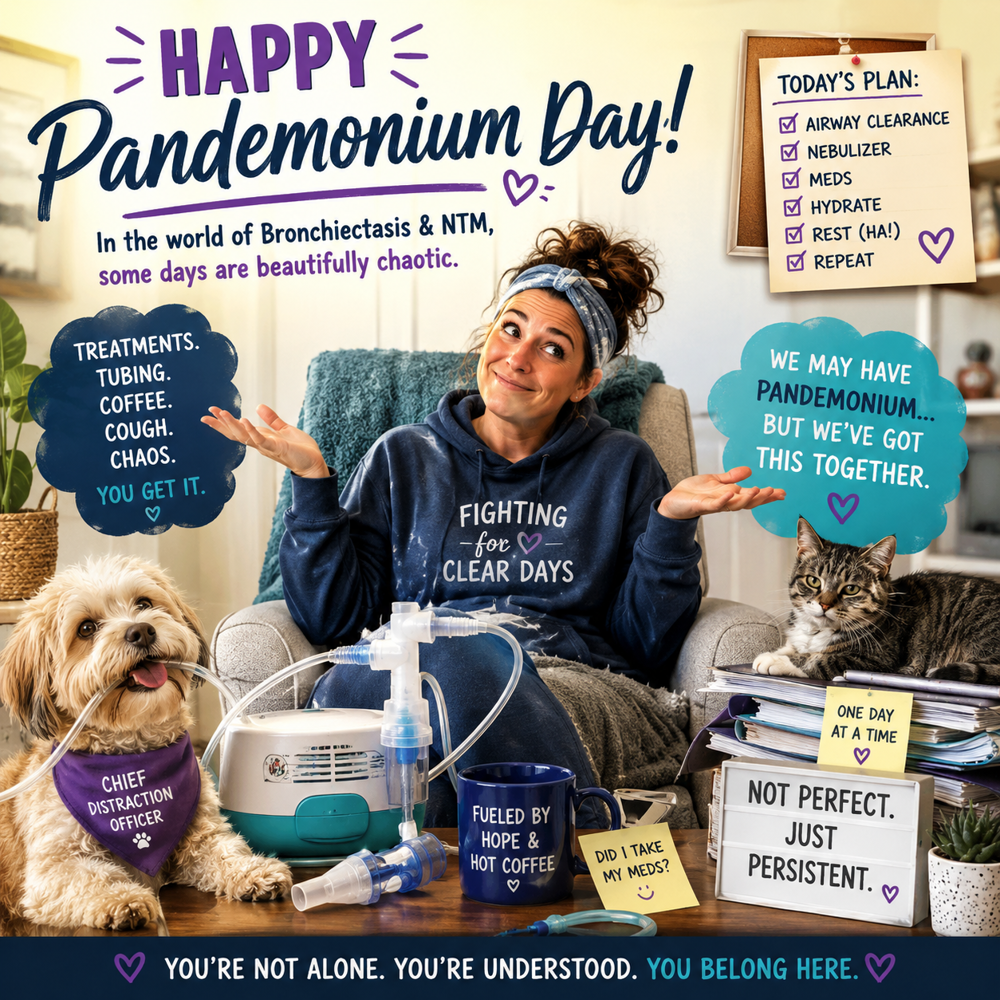
🎉 Happy Pandemonium Day! 🎉
Ever have one of those days where it feels like everything is happening all at once?
Your airway clearance routine takes longer than expected. The nebulizer decides it's going to beep at just the wrong time. You can't remember if you already took your medication. Your to-do list keeps getting longer, and somehow your coffee is cold... again. 😄
Living with bronchiectasis or NTM isn't always predictable, and some days can feel like a little bit of pandemonium.
But here's the good news—we've all been there.
Today, let's find a reason to smile together.
💙 What's your funniest "pandemonium moment"?
Maybe you got tangled in your nebulizer tubing.
Maybe you started your treatment and realized the medication was still sitting on the counter.
Maybe your pet decided airway clearance time was the perfect time for cuddles.
Or maybe you just had one of those days where nothing seemed to go according to plan.
Share your story, a photo, or a moment that made you laugh.
Sometimes the best part of this community is realizing we're not the only ones who have those wonderfully chaotic days—and being able to laugh about them with people who truly understand. 💙
💙 Hope Starts with Knowledge.
For individuals and caregivers living with BNTM, learning about clinical trials can lead to better outcomes by giving eligible participants access to promising investigational therapies under careful medical supervision.
Participation is always voluntary, and every study has specific eligibility criteria. The best first step is to talk with your healthcare team to see whether a clinical trial may be right for you.
Every breakthrough in medicine begins with people who choose to advance research. Patient involvement helps researchers better understand the disease, identify unmet needs, and develop treatments that reflect what matters most to those living with BNTM. Whether you participate or simply help spread awareness, you are contributing to a future filled with more hope and more treatment options.
Progress happens because of a community that shows up, supports one another, and believes that better treatments—and brighter tomorrows—are possible. Together, we're moving science forward—one step, one study, one patient at a time. I will be posting information on clinical trials and current trials throughout the week. Please stay tuned and let us know if you have any specific questions on clinical trials.💙
Hello! I hope that you have been able to enjoy some beautiful summer days. Below is a link to a blog article on Summer Precautions for Bronchiectasis and NTM individuals. The article reviews water precautions- the latest update is to boil water for at least 3 minutes after it begins to boil. Please let us know if you have any questions.https://social.bronchandntm.org/articles/blog/Summer-Precautions-for-People-with-Bronchiectasis-and-NTM-Lung-Disease
💙 As a part of Therapeutic Recreation Week, it is recommended to get involved in your local community. Living with bronchiectasis or NTM lung disease can sometimes feel isolating, but connecting with your community can help build friendships, purpose, and support. Do make time for connection- other people will learn to understand you over time, and your need to cancel or postpone an event as needed.
✨ Ways to get involved in your local area:
✅ Volunteer with a local nonprofit or community organization
✅ Attend library events, workshops, or book clubs
✅ Participate in community recreation or wellness programs
✅ Visit local parks, community centers, or senior centers
✅ Connect with faith-based or civic organizations
✅ Attend health fairs and community education events
Remember, involvement doesn't have to be big to be meaningful. Whether it's attending a monthly meeting or volunteering for an hour, small connections can make a big difference. Community reminds us that we are stronger together. Every connection is an opportunity to learn, grow, and support one another. Do you want to share your experience with a community group in your area?
SusuG,
Below is a video on the management of Acid Reflux. I hope that this information assists you. https://m.youtube.com/watch?v=lf_hSgJ21BY&ra=m#fauxfullscreen
SusuG,
Below is a link to Basic Nutrition for BNTM patients . Let us know if you have any questions. https://www.bronchandntm.org/For-Patients/Learn-More/Managing-Symptoms-and-Daily-Living/Nutrition
SusuG,
Hello! Welcome to the community. Have you been doing regular airway clearance? Do you have an aerobica or Acapella device?
Are you staying with an anti reflux diet? Is your heading bed elevated at least 30 degree angle?
Below is a link to Basic Nutrition for BNTM patients . Let us know if you have any questions. https://www.bronchandntm.org/For-Patients/Learn-More/Managing-Symptoms-and-Daily-Living/Nutrition
Brandon,
Your pets are absolutely adorable. I no longer have a dog 🐶; my little Bischon Frisée , Rocco went to doggy heaven a few years ago. I miss him dearly- he was very intuitive. Rocco would follow me around the house on days when I was not feeling well.
Healing is certainly found in true connection, and laughter. Being around an uplifting person who you truly connect with, makes you laugh is the best medicine of all. 😍
Just joined this group. I was diagnosed with BE a couple of years ago during a hospital stay for pneumonia. That year, I had about 4 bouts of pneumonia which I think contributed to my diagnosis. Prior to that I had coughing when i changed positions in bed or when I had a cold. I was having lots of coughing and throat clearing at the time of my pneumonias. I think I have silent reflux, which makes it difficult to manage my BE. I’m starting to watch my diet a little more, taking reflux gourmet at night when I need it, and doing hypertonic 3% nebs twice a day. Any suggestions how to manage both issues? I’m 70, 4 grandkids and am pretty active. Thanks.

🐾 Companions Through Every Breath 💙
Friday is Chronic Disease Day, and it feels like the perfect opportunity to recognize something that often brings comfort while living with bronchiectasis or NTM.
Managing a chronic lung condition can mean treatments, airway clearance, medications, appointments, and learning to adjust to both the expected and unexpected. While those routines are an important part of the journey, so are the little moments that help us recharge.
For many of us, those moments come with a wagging tail, a gentle purr, cheerful chirps, or simply the quiet presence of a beloved companion nearby.
Our pets don't take away our diagnosis, but they often remind us to slow down, smile, and appreciate the present. They seem to know when we need a little extra comfort and offer unconditional companionship on the hard days while celebrating the good ones with us, too.
In honor of Chronic Disease Day, I'd love to celebrate the companions—and the simple moments—that help brighten life's journey.
🐶 Share a photo of your pet.
🐱 Tell us about a furry, feathered, or even scaly friend who has been by your side.
💙 If you don't have a pet, I'd love to hear about something that brings you comfort, peace, or a smile on the more challenging days.
Sometimes healing isn't just found in treatments. It's also found in connection, comfort, laughter, and unconditional love.
I can't wait to see the special companions and moments that help brighten your days. 💙🐾
☀️ Summer may bring some hot and humid days, but that doesn't mean the fun has to stop by any means! If you're spending time indoors to stay comfortable, it's a great opportunity to explore a new hobby, get creative, or revisit an old favorite. Here are a few places to spark your creativity and keep you engaged:
🎨 Michaels – The largest nationwide arts and crafts retailer, with supplies for painting, knitting, Cricut, floral, framing, and more. Find everything from painting and knitting supplies to Cricut materials, floral crafts, framing, and so much more. https://www.michaels.com/
🧶 Hobby Lobby –A large craft and home décor chain with a wide range of craft materials. Browse a wide selection of arts and crafts supplies, DIY projects, and home décor inspiration. https://www.hobbylobby.com/?msockid=0ca9b0b92ddf6727275ca33b29df6150
🚂 HobbyTown – Perfect for model kits, RC vehicles, trains, tabletop games, puzzles, and other specialty hobbies. https://www.hobbytown.com/
Whether you're creating something beautiful, building a model, or simply enjoying a relaxing afternoon with a favorite pastime, staying engaged can make indoor days just as enjoyable. Do you have a favorite hobby that you would like to share with the community? 💙
I would add the gift of HOPE that inspires every individual on their BNTM journey to keep moving forward one step at a time. :)
Throughout National Therapeutic Recreation Week, we encourage our bronchiectasis and NTM community to look into courses that can improve their quality of life. Self-care means celebrating what I can do today, not comparing it to yesterday. 💙 I may need to pace myself, but indoor courses such as the one below help me stay connected to my personal/professional goals.
Coursera offers hundreds of free online courses across diverse subjects, with options to access course content and, in some cases, earn certificates at no cost. Coursera allows learners to start free courses in two main ways: by previewing the first module of many courses, which includes video lessons, readings, and graded assignments, or by starting a 7-day free trial for Specializations or Coursera Plus. Check out the link below if you are interested in learning something new and exciting. Have you attended any of the Coursera classes?
➕ Here's a few of my own Bronch & NTM Math equations to get us started... 😊
☕ Morning coffee + Bronch & NTM360social = A great start to the day.
💙 BNTM360social + members who genuinely care = A community that reminds me none of us walks this journey alone.
💬 Asking one question + people who understand = Support, encouragement, and often a few great ideas to try.
🌅 One beautiful sunrise + a few quiet moments = A fresh perspective.
🐾 A furry friend + treatment time = The best little therapy buddy.
📖 Learning something new + sharing experiences = Confidence for the next step.
😊 One smile + one kind comment = A day that feels just a little brighter.
🤝 Giving encouragement + receiving encouragement = That's the kind of math that always adds up.
Now I'd love to see your Bronch & NTM equation! What would you add? ➕💙

➗ Happy Math 2.0 Day! ➕
Today seemed like the perfect day for a little "Bronch & NTM Math." 😄
Sometimes the numbers don't matter nearly as much as the little moments that make up our day.
Here's a few equations many of us might recognize...
💨 Airway clearance + patience = A step toward breathing a little easier.
🫧 Nebulizer treatment + a favorite TV show or book = Time well spent.
🔍 One missing inhaler or nebulizer cup + five minutes of searching = It was right where you left it... of course!
🧺 Freshly washed nebulizer parts + time to air dry = The waiting game.
🐾 One curious pet + treatment time = A faithful little helper (or supervisor!).
❤️ One encouraging comment + this community = A reminder that you're never walking this journey alone.
Now it's your turn!
If you could write your own "Bronch & NTM Math" equation, what would it be?
Maybe it's...
☕ Coffee + a quiet morning = A peaceful start to the day.
🌿 A favorite view + a few deep breaths = A moment to recharge.
📚 Learning something new + support from others = More confidence for tomorrow.
😊 One smile + one kind word = A brighter day.
Sometimes it's the smallest things that add up to the biggest difference.
I'd love to see your funniest, sweetest, or most relatable "Bronch & NTM Math" equation in the comments. Let's have some fun with it! ➕💙
Pam,
Below is additional information on medical grade purifiers, that are more expensive than the average purifiers. If you scroll down, it explains how to choose the best purifier based on square footage. I hope this information helps you. Keep safe.
Pam,
Hello! I am so sorry to read that the fires are getting worse. Below is a link to the top Heppa air purifiers. Each one comes with a description of the space they cover and more. https://www.consumerpicks.org/top-10/hepa-air-purifiers?msclkid=223b4f7c777212a6a63225315f6a894e
Dr. Solomon's great - I think the community is going to appreciate this one!
Brandon,
I absolutely love this post. Many of us type A personalities who attempt to keep on keeping on despite their challenges. After many years, and learning about The Acceptance and Commitment Theory, it is still challenging to admit and accept my limitations at times. One of the lines in your that resonated with me was “I wish people understood that some days are harder than others.”
I had written a blog article on this subject in the past:https://social.bronchandntm.org/articles/blog/Its-okay-not-to-be-okay-with-NTMBronchiectasis-Overcoming-fear-related-to-being-diagnosed-and-dealing-with-an-ongoing-chronic-diagnosis
I hope you have a good day! 😊
The Bronchiectasis and NTM Association announced today that research leveraging data from the Bronchiectasis and NTM Research Registry was featured in four abstracts presented at the World Bronchiectasis Conference, held June 24-27, 2026, in Hannover, Germany.
As of today July 7, 2026, the fires are getting worse in Colorado, affecting air quality. Should a person with bronchiectasis utilize an indoor air filter? If so, could you give any recommendations as to what to look for when purchasing one? Perhaps size, one that covers only one room or a large area, type of HEPA filter?
Hi Stevm.
This is a good question! I am glad that you brought it up. What we have heard is that there is a lower prevalence of NTM in states like North Dakota, South Dakota, Wyoming, and Montana; however, I say that with a caveat. It could be that we don't have enough data from those states to accurately measure the prevalence (not to mention that it may be hard to find expert care in those states as well). As Katie mentioned, there are various types of NTM everywhere. However, if living in Washington doesn't seem to be positively affecting your health, I can understand wanting to relocate. Are you being seen by a provider at a CCN center now? Just curious.

🤍 Tell the Truth Day: What's One Truth You'd Like Someone to Understand?
Today is Tell the Truth Day, and I thought it would be a good reminder that sometimes the bravest thing we can say is the truth.
Maybe your truth is...
💙 "I'm more tired than people realize."
💙 "I miss doing the things I used to do."
💙 "I'm afraid of becoming more short of breath."
💙 "I wish people understood that some days are simply harder than others."
💙 "I don't always ask for help when I probably should."
Living with COPD, bronchiectasis, or NTM can sometimes make us feel like we have to put on a brave face. But being honest with your family, your friends, your care team—and even with yourself—isn't giving up. It's how people know how to support you.
The truth also helps your healthcare team make better decisions. If you're having more symptoms, struggling with treatments, or finding everyday tasks harder than they used to be, don't be afraid to say so. Your voice matters.
So, if you're comfortable sharing...
💬 What's one truth you'd like others to understand about living with COPD, bronchiectasis, NTM, or being a caregiver?
You never know—your honesty might be exactly what someone else needs to hear today. ❤️
It is not our intention to serve as a substitute for medical advice and any content posted should not be used for medical advice, diagnosis or treatment. We make every effort to support our members, our medical professionals cannot and will not provide a diagnosis or suggest a specific medication; those decisions should be left to your personal medical team. While we encourage individuals to share their personal experiences with Bronchiectasis and NTM, please consult a physician before making changes to your own Bronchiectasis and NTM management plan.
Community posts are monitored by the 360social Community Manager, as well as staff respiratory therapists, educators, and other medical professionals.